Greetings from Switzerland, home of the timeless classics Swatch Watch, Toblerone, and fondue. We began our Swiss adventure in Interlaken, a small town that is bordered by lakes to the east and west, and by the Bernese Alps to the north and south. The town itself is quaint and very clean, and the surrounding wilderness is gorgeous. Unfortunately, Interlaken is also quite expensive, so we ended up staying in a hostel. It wasn’t too bad, although we had a room right next to the only bathroom on our floor, making it a high-traffic area. And as with almost any hostel, there were a few less than classy individuals staying there who preferred to stay out late, cause trouble, and make a racket into the morning hours. Interestingly, Swiss law mandates that excessive noise is illegal after ten o’clock in the evening and will be prosecuted to the full extent of the law (whatever that means). But it was the cheapest option in town, so it was our best option. The hostel also offers a wide assortment of extreme sports and excursions like paragliding, bungee jumping and canyoning. We decided that maybe when we return to the area we’ll try paragliding. We saw so many people toward the tops of the mountains sailing in the sky. It seems like it would be a fantastic way to view the Alps.
 Our mission for the first full day in Switzerland was to take in the natural beauty of the Swiss Alps and do a little hiking. Our top destination was the Schilthorn, a peak reaching over 9,700 feet in elevation and providing fantastic views of the surrounding mountains. We started off by travelling to the nearby village of Lauterbrunnen by a small private train and then through Lauterbrunnen Valley by bus. The valley rivals the natural beauty of Yosemite with its towering vertical rock faces and waterfalls. When we reached the south end of the valley and the base of the Schilthorn we found a cable car system based there, whisking passengers up and down the side of the mountain. It was coincidentally about that time we decided the day would include more of the sightseeing side of things and less hiking. We rode the cable car to the top, stopping along the way to explore some of the villages perched on the mountainside and to take in the stunning scenery. From the top we had fantastic views of the Eiger, the Mönch, and the Jungfrau, some of the highest and most impressive peaks in Switzerland, and Europe for that matter. The cable car station at the peak of the Schilthorn also houses a revolving restaurant and several gift shops selling Ja
 mes Bond themed souvenirs. The peak was the setting for the 007 film “On Her Majesty’s Secret Service” starring George Lazenby. It’s not one that we’ve seen, but then again we haven’t seen many older Bond films. The movie made the Schilthorn peak famous, even though in the movie the station was apparently blown up. There is an observation deck outside that goes all the way around and provides a breathtaking vantage point of the surrounding mountains. Our original plan for the day was to hike to this point, until we realized just how high that really was. In addition, the snow would have done quite a number on us as we were ill prepared for even the slightest snowfall. The only hiking we ended up doing was some walking around in the villages of Gimmelwald and Mürren. On our village walking adventure we came across a field of grazing cows, which is a common site throughout rural parts of Switzerland. The difference with the Swiss cows is that they are musical: all of them have giant bells around their necks of different sizes that chime and ring as they graze. It is quite a harmonious symphony.
 The following day we decided to get some real Swiss Alps hiking done. After putting on multiple layers of the shirts, jackets and socks we packed, we took a train to the small town of Grindelwald, which is on the opposite side of the Kleine Scheidegg from Lauterbrunnen, where we were the previous day. Our goal was to hike to Mänlichen, a small peak on the same ridge as the Kleine Scheidegg that reaches 6,761 feet in elevation. We took a private, two person gondola (similar to the cute ones from Disneyland) from Grindelwald halfway up the mountainside, and hiked the rest of the way. This, I assure you, was not at all cheating. The gondola ride was fantastic, however the weather was not. We were still able to get decent views of the surrounding villages, valleys and mountains, all while listening to the grazing cows below. Normally this hike would have provided great views of the Bernese Alps, but because of the weather we weren’t able to see much. To make matters worse, we took a detour we probably shouldn’t have through a swampy area and ended up splattered in mud. By the time we reached the top it was raining with some snow mixed in and both of us were cold, tired, and a bit cranky. We thought it over and reached the conclusion that taking the gondola all the way back down to Grindelwald would also not be cheating. After a long ride back down, reflecting on our day, we decided to pack it in at the hostel and take it easy. Probably the only good thing about a hostel over a hotel is the use of a full kitchen. We stopped by the local grocery store for the goods and made the first “home cooked” meal we’d had since we stayed with the family in Hamburg. Nothing is better after a cold and long day than delicious pasta and garlic bread. We were also fortunate enough to have found a place that offers coin operated washers and dryers. We had not had freshly laundered clothes since Hamburg as well. After dinner, laundry and splitting a Toblerone, we went to bed tired, stuffed and smelling good.
 The next morning we left early at headed south to Zermatt, home to the famous Matterhorn. Nestled near the Italian border, Zermatt is a picturesque town just begging for the attention of tourists. Every view of the city would be a perfect postcard. The main streets are lined with shops and expensive restaurants and hotels. We arrived just after noon and quickly realized that between noon and two all of the shops are closed, I suppose for an extended lunch. Therefore our day started out with a bit of window shopping. Not a single gas-powered vehicle was in sight as the city does not allow them. Instead, electric carts and horse-drawn carriages offer the affluent a ride about the town. Often between the newer buildings stand what appears to be dilapidated shacks but are actually original homes and foundations from 18th and 19th centuries. It definitely is an interesting contrast when one is right next to a brand new hotel. Our hotel definitely was not brand new, and in fact had a décor that smacked of the seventies. It made us want to buy turtleneck sweaters and have a fondue date night. We probably would have too if restaurant fondue weren’t so expensive. Even though the hotel was living in the past, it was situated in the perfect spot: right outside the front door was a full view of the Matterhorn. Or at least it would have been were it not for the group of clouds surrounding the top. We waited patiently for the clouds to disperse, but every time it appeared to be happening the winds would pick up and blow the opposite direction, making the top barely visible. While waiting, we struck up a conversation with an older gentleman from Indiana who told us all about his days traveling through Europe as a youth in the sixties. He also diverged into some stories about his army days and when he used to wear an onion on his belt. We enjoyed our talk with him, but when we realized that the clouds were not going anywhere we decided to head back into town. Zermatt nightlife is typical of most places, that being bars. Therefore we decided to pack it in so we could wake up early and go for a quick hike before departing to our next destination. The following morning the clouds were still hanging around during our hike. We had to constantly be watching for when the Matterhorn might be unobstructed so we could get at least one good picture. Finally, during the last hour before we had to catch our train, the clouds dispersed and we were able to get some very nice shots. It was a good thing we were patient, otherwise it would have been disappointing to have traveled so far and not be able to marvel and the full majesty of the Matterhorn.
Coming up: Salzburg and Vienna, AustriaInterlaken:Zermatt:
 We left Prague on a Saturday, which was probably a mistake since we were travelling into Munich during Oktoberfest. The train was packed, mostly with Americans, and Mark was stuck sitting in the dining car for five hours, forced to buy awful train food. We would definitely have traveled to Munich regardless of the annual festivities, but we figured if we were going to be in the area, we may as well go to Oktoberfest. We both had our own interpretations of what it was going to be like, and we were quite surprised by what we saw.
First, the whole city was packed. We couldn’t find a hotel within an hour’s train ride, but we were actually happy to not be in a full hotel with rowdy people near the fest. As we approached the festival grounds we discovered that Oktoberfest is much the same as any county fair, like the Puyallup fair for those of you in Washington, only with drunk people everywhere. Maybe it’s the same as the Puyallup in that way as well. There are fair rides and carnival games, deep fried foods and a kid’s area all situated between the city center and historic churches. Yes, there are beer halls, brats and giant pretzels being sold, but also swarming masses of people excited for the party. We went to the fest that Saturday and upon arrival Mark got a beer outside but not able to get into a hall. On the weekends, reservations are required to join the festivities inside the halls. I was determined to eat a giant pretzel, just to partake in something cliché since I don’t drink. It fest wasn’t the most enjoyable experience as a non-drinker, but it was still an experience nonetheless. As for the crowd, I would wager that there were more foreigners mingling about, mostly Americans and Australians. But there definitely were Germans, and a lot of them were dressed in old-fashioned Bavarian garb: low-cut Dirndls for the ladies and Lederhosen for the fellas. I thought that type of dress was releg
 ated only to those who work at the fest, but apparently it’s quite popular to don the traditional outfits as a party-goer. We always knew we were on the right train to Munich if we saw the young adults dressed that way. We left that evening a little down considering the weather was gloomy and the crowd was rowdy. But we decided to return on a Tuesday afternoon to see if things would be a bit calmer. Thankfully our intuition was correct; we were able to walk right into the once over-stuffed Spatenbräu beer hall to view the festivities inside. There were still a lot of people that day, but not so much that it became uncomfortable. The hall was decorated with white and blue streamers and brightly lit. A fully orchestrated Bavarian “oompah” band was in the center keeping the crowd entertained. Traditional songs were sung and we were witness to a “Zicke zacke zicke zacke hoi hoi hoi” as well. It looked like everyone was having so much fun that it made our Oktoberfest experience totally worthwhile. If we had not returned to see the hall, which is what we had envisioned the fest to be, we may have left with a bitter feeling about the whole affair.
While in Munich we took a New Europe tour, but this time it was a paid tour that focused on the rise of the Third Reich. Once called “The Capitol of the Movement,” Munich was the birthplace of Hitler’s dictatorship and the tour took us to the various spots where history was made. We visited the infamous Hofbräuhaus were Hitler effectively swayed the people towards National Socialism. We learned about his early days before the movement and his struggles as an artist. It’s amazing to think what the world would be like if he had been an accomplished and accepted artist instead of…well, you know. Our tour guide detailed the resistance to the movement, although in many ways it was subtle since the consequences for betrayal were extremely harsh. We learned a lot about how devastating the Versailles Treaty was to Germany after the First World War and how that lead to a collapsed economic system. The country was completely unstable and yearned for a solid government. All it took was one charismatic leader to persuade the people toward an outrageous ideology. At the end of our tour our guide explained how now, three generations later, Germans are still trying to cope with the tragedy. It is abundantly clear that although countless amounts of people were hurt by the war, so too were many Germans.
 After the tour we decided to look up the locations visited on the free tour that we missed to try and see as much of the city as we could. Our first stop was the tallest church we’ve seen thus far, the Frauenkirche, or Church of Our Lady, built in the twelfth century. Two extremely tall bell towers climb over three hundred feet into the air and can be seen from all around the Marienplatz center. Unfortunately one of the towers was under construction and was not as enjoyable to look at. There is a legend about this church involving the devil. It’s said that during its construction, the devil came about and noticed that the bell towers had very few windows on it. He made a deal with the builder to not put any more in the church. The builder agreed and continued on with construction. When it was complete, the devil returned and was dismayed to find more windows. The builder said that the windows were there before he made the pact with him and that the devil must not have noticed them. In a fury, the devil stomped his foot down on the pavement, leaving an indentation that is still there today, known as the devil’s footprint. It does, however, look as though the devil was wearing shoes, so I’m not sure how much credence there is in this tale. There is a picture in the slideshow. A short distance away is the Marienplatz, which is directly in front of the new town hall, and very close to the old town hall. Twentieth century romanticism struck again as we found that the new town hall was build to look much older than it really is.
 We took a full day during our stay in Munich to visit Neuschwantstein castle in the nearby Bavarian Alps. The train ride lasted about two hours each way, so we were committed to a full day excursion. The train took us as far as Füssen and from there we took a quick bus ride to Hohenschwangau, followed by a twenty minute hike to the castle itself. The weather was overcast and gray, therefore our pictures are not as spectacular as they could have been. There are some really gorgeous pictures on google images, if interested. Neuschwanstein served as the inspiration for Sleeping Beauty’s Castle at Disneyland. The castle was pretty awesome, architecturally speaking, and was very picturesque given its location in the foothills of the Alps. Unfortunately the guided tour of the inside was less awesome, as our guide had a very thick German accent and an all around creepy demeanor. Despite that fact, the trip was well worth it because of all the beautiful scenery, which included a pretty incredible waterfall under a suspension bridge over which we could walk to get amazing views of the castle.
We had a lot of fun in Munich and at Neuschwanstein, but like most cities so far there just wasn’t enough time. We missed going to the Dachau concentration camp, one of the first in Germany, which would have been a sobering experience. It would be great to visit Munich again, but maybe not during such a hectic time like Oktoberfest.
The train is rollin’ to: Interlaken and Zermatt, Switzerland
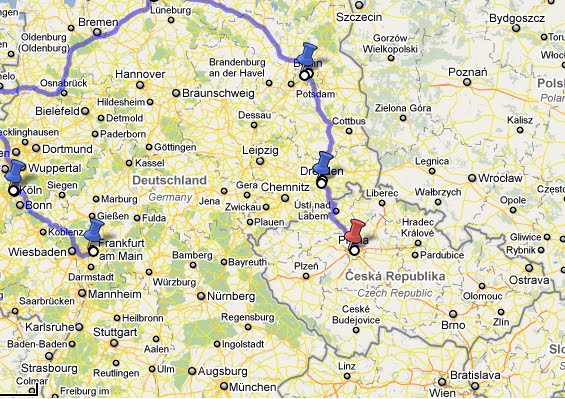
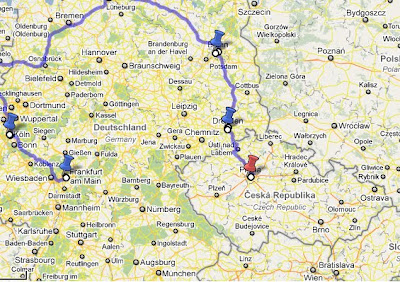 Here it is: the Prague blog! I love saying that. We had a smooth ride from Germany into the Czech Republic; Dresden is only two hours away from Prague. The landscape between the two countries is very beautiful and lush. It was one of the few times that we paid attention to the scenery on board the train. We really didn’t know what to expect from Prague, other than it being a very old city and vastly different than anything we’ve seen so far. As one of Central Europe’s largest cities, Prague has a history that dates back to the ninth century. It is the heart of medieval Bohemia and once the capitol of the Holy Roman Empire. For most of the twentieth century, the city was oppressed both by the Nazis and the Communists. Fortunately, the original structures and churches remain intact and did not suffer much if any devastation in both World Wars.
 As soon as we exited the train, we threw our bags into lockers and headed for the old part of town. We had just enough time to make it to the last New Europe tour of the day, and we wanted to make the most of that evening. We made our way to the Old Town center and were immediately swept up in the swarming crowds. Prague has become a popular tourist destination because of its unique history and it's really inexpensive. The center is surrounded by some of Prague’s most recognizable structures, most notably the gothic Týn Church and the first ever Hussite church. Construction on the Roman Catholic Týn Church began in 1256. Our tour met in front of the Astronomical Clock at the Old Town Hall, which was just in time for the hourly clock performance. There are marionettes placed on the sides of the clock that dance and jingle every hour until nine at night. One of the figures is a skeleton, and he is ringing a bell to tell everyone that it’s time to come with him
 , essentially that our time is up. Once the bells were through chiming, a trumpeter on the balcony of the tower began to play for the crowd. The clock’s origins date back to 1410, although it has had multiple upgrades since, and has a somewhat morbid but historically untrue legend associated with it. It was believed that the original clockmaker was blinded on the order of the Prague Councilors so that he could not repeat his work; in retaliation, he broke the clock, and no one was able to repair it for the next hundred years. Of course now it is widely known how the clock works, although not many understand it. Our tour first took us to the Jan Hus monument in front of the Týn Church, memorializing the creation of the Hussite religion. Jan Hus was a member of the Roman Catholic Church, but at the time he did not agree with the Church’s policy on the treatment of the wealthy over the poor. He wanted to create a similar religion that treated people equally, regardless of their social standing, and built a church right across the way from the Týn. Naturally, the Catholic Church disapproved and wanted to quell any such deviations, which effectively lead to the Bohemian Wars. And it didn’t end well for either side. I didn’t know that there was an actual term for throwing someone out of a window, but apparently it’s called defenestration. A lot of people were defenestrated back then. Our tour moved on around the corner to the concert hall where Mozart first performed the opera Don Giovanni. We saw the two buildings in Prague that were inspired by Cubism, and they definitely looked out of place in a traditionally brick and cobblestone neighborhood. A grim tale was told at a church around the way: a thief walked into the empty church at night and saw the statue of Mary had a gold chain around her neck. Being a thief, he decided to steal the necklace while no one was around. Just as he grabbed hold of the necklace, the statue of Mary came alive and clasped his arm with her hand, then solidified into a statue once more with the thief’s arm in her stony grip. The thief yelled and cried for help, and soon woke the priest who came to his aid. Unfortunately, they were unable to free his arm despite all their efforts and decided that the arm had to come off. The thief was relieved and elated that Mary’s arm would be removed, until the priest told him that it would be his arm, not the statue’s, which would be taken off. The priest felt that if the statue grabbed the thief’s arm because he was trying to steal from her, what would she do to him if he tried to cut her arm off? And through much torment and pain, the thief’s arm was finally cut, and at that moment the statue dropped the severed arm to the ground and resumed her original position. The arm was kept and preserved as a warning to other thieves in the area and still hangs on a chain from the church ceiling. We were able to see the “arm” but not able to take pictures, not that I would want a picture of that. It doesn’t look much like an arm anymore, and I’m sure it is only a demented fable. Our next stop was the Jewish Quarter, an area with a deep and sad history. The Jewish people in Prague were subjected to segregation for several centuries before the Second World War. They were forced to live on lands that no one else wanted because of constant, terrible flooding. Because of economic disparities, the area became a ghetto.There is a Jewish History Museum that is supposed to be incredibly touching. Our guide told us that there are drawings on the wall just inside the museum that children drew while in the concentration camps and the story of the woman who was able to smuggle the drawings out. We really wanted to
 visit the museum, but unfortunately it was closed due to a religious holiday. There are multiple Synagogues in the Jewish Quarter, all built at different points in the area’s history. The Spanish synagogue, which actually resembles a Mosque, is a tribute to the golden age of Jewish culture in Spain. The most interesting is the Alt-Neu, or Old New, Synagogue, which is the oldest active Synagogue in Europe. There are actual stones from Jerusalem that are in the foundation that are on loan and are required to be returned at the time of the Rapture. Inside the Old New Synagogue is rumored to house a Golem, a giant man-like statue that can come alive by a spell and do its masters’ bidding. The story goes that the Golem ran amuck in the city and the spell had to be broken. The statue is said to be sitting in the attic of the Synagogue, but no one is allowed to see it. There is a story of a Nazi soldier who wanted to see the Golem and snuck into the attic from a small window on the outside, and he was never seen again. Across the way is another Jewish building that has a Hebrew clock, which no one on our tour could understand. Our tour ended at a memorial for Czech student Josef Smrkovsk who set himself on fire in 1969 to protest the Communist rule of the city. The evening was upon us and we were advised by our guide to take a stroll along the Charles Bridge. Built by King Charles IV in the fourteenth century, the bridge is adorned with over twenty statu
 es of different religious themes. There were actually two bridges prior to the one we were on, but they were not structurally sound and eventually washed away. On the other side of the bridge is the Hradčany, the castle district. There are several more churches and cathedrals on this side, known as the lesser quarter, all in the shadow of the ominous Pražský hrad, the Prague Castle. Through the tight alleyways paved in uneven cobblestones, we made our way up the steep hill toward the castle. It is the world’s largest medieval castle and certainly one of the oldest. The castle’s origins date back to the year 870, but it was rebuilt in Gothic style by King Charles IV and was finally completed at the end of the twentieth century. His tomb was apparently buried several centuries after his death during the construction and was covered for over one hundred and fifty years. The castle itself is impressive on the outside, but we decided instead to walk along the castle wall and enjoy the panoramic views of Old Town and beyond. We later found the John Lennon Memorial Wall down the hill, which is pretty much just a wall open for Beatles themed graffiti.
 Prague is an incredibly interesting city with a deep and often times gruesome history. Over almost a dozen centuries, Prague struggled between periods of political stability and strife. We were really fortunate that a New Europe tour was offered there; otherwise we may not have taken an actual tour of the city. Prague is definitely a tourist destination now, but it’s only been in the last few decades that travel was so easily available. The city as well as the state was under a deep depression during Communist rule, but it seems to have made a complete recovery and thrives on the attention it receives from the traveling community.Our next stop: Munich and Oktoberfest
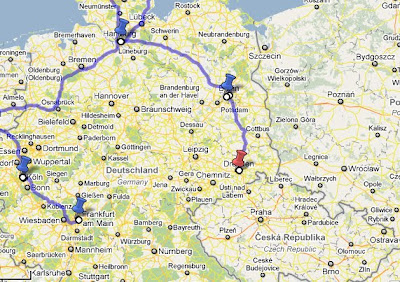 Berlin really took a lot out of us. We wanted to do as much as we could, and by doing so we became incredibly exhausted. Thankfully, Dresden was only a short two hour train ride away. We made it into the city in the early evening and decided to rest for the night. Our hotel was also partially a hostel, so there was a bizarre mix of retirement-aged travelers and teens mingling about and making noise. From our room we had a view of the old town which had many church spires piercing the skyline.
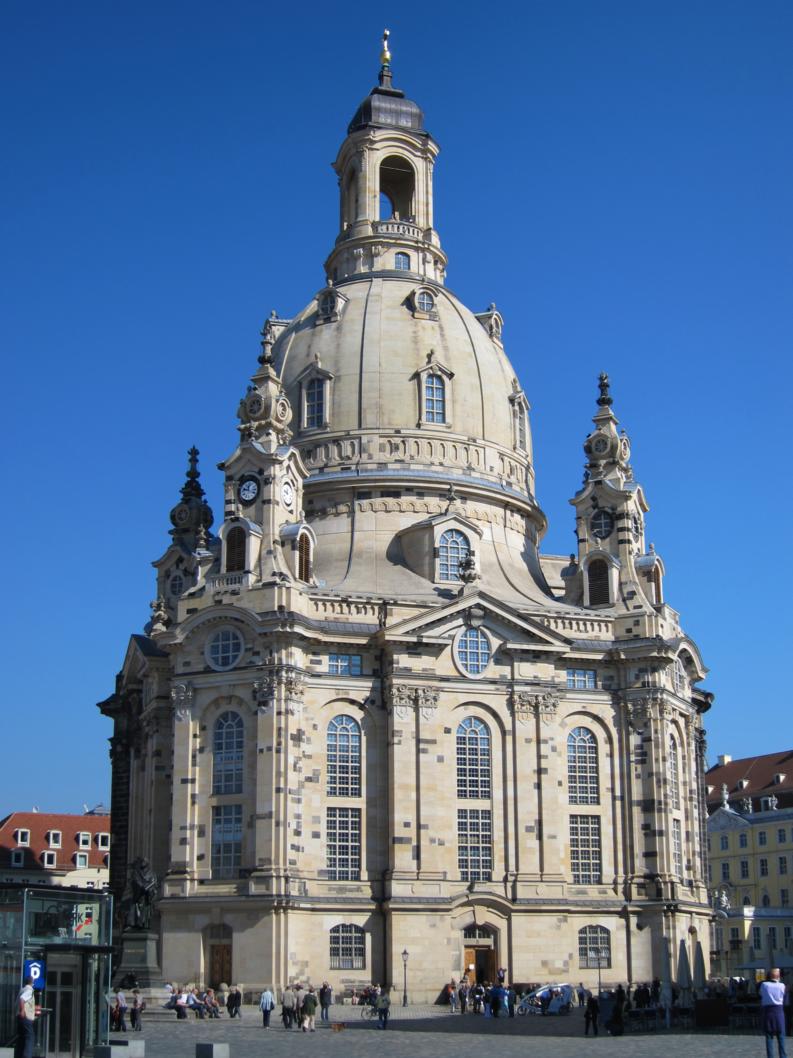
 Our morning began like most so far, on foot. We walked into the center of the old town where an autumn carnival was taking place. Enormous cathedrals punctuated just about every block leading up to the river. Dresden was once home to several generations of Saxon kings and was known as a cultural and industrial center, rich with priceless art and famous architecture. Then it was repeatedly firebombed by Allied forces for two days in February of 1945. Buildings that survived show evidence of the devastation, scorched and blackened. It took several decades but the city has finally rebuilt itself to its former stature. One key structure used as an example of the city’s rejuvenation is the Frauenkirche, the Church of Our Lady. Below are pictures of what the church originally looked like, after the bombing and finally rebuilt using as much of the rubble as was possible.
 The portion still standing after the bombing is intact today. Any of the blackened stones shown are original pieces of the structure that were reclaimed and used in the rebuilding process. The reconstruction of the Frauenkirche was finally completed in 2008. Most of the buildings that were destroyed were rebuilt to look exactly the way they were before the war. It is amazing to see such perseverance for original restoration considering that larger cities moved on after the destruction with newer facades. Unfortunately, most of the buildings are not marked as to whether they have been completely rebuilt or if they survived, so it’s hard to tell how old some buildings really are.
One inspiration for our stop in Dresden was to find schlachthof-fünf, the location where author Kurt Vonnegut survived the bombings as a prisoner of war in an underground meat freezer inside of a slaughterhouse. There were no clear directions to the location, and not many knew who Vonnegut was. Our only clue was to find a placard across from a bus station near a sports complex. Our search took us around the area for about three hours, often feeling as though we were aimlessly searching for something that could not be seen. But fatigue did not hinder us; we were determined to find it before the sun went down. Our resolve paid off as we finally spotted the placard hidden conveniently behind a tree. It tells the story of the bombings on one side and a quote from the novel “
 Slaughterhouse-five” on the other. Unfortunately, both sides are written in German. The only sentence I can make out is “So geht das” (So it goes). We were both joyous yet restrained, having found what we were looking for but understanding what that building represents. The story goes on about how the POW’s were forced by the Nazis to collect the burned bodies from the city, but there were just too many. So the Nazis decided to go through the city with flamethrowers and crudely cremate the bodies left behind. It has been estimated that just under thirty thousand people perished in the bombings. We both felt thankful that the city kept the buildings intact, although we’re not sure why they did. They don’t have any marks of recognition other than the obscure one at the bus station, and it’s not a part of the city’s overall must-see cultural experience. In fact, it’s mostly obscured by a modern sports complex and a school. But for us, we wouldn’t have missed it for anything.
Next stop: Prague, Czech Republic
 Greetings from Switzerland, home of the timeless classics Swatch Watch, Toblerone, and fondue. We began our Swiss adventure in Interlaken, a small town that is bordered by lakes to the east and west, and by the Bernese Alps to the north and south. The town itself is quaint and very clean, and the surrounding wilderness is gorgeous. Unfortunately, Interlaken is also quite expensive, so we ended up staying in a hostel. It wasn’t too bad, although we had a room right next to the only bathroom on our floor, making it a high-traffic area. And as with almost any hostel, there were a few less than classy individuals staying there who preferred to stay out late, cause trouble, and make a racket into the morning hours. Interestingly, Swiss law mandates that excessive noise is illegal after ten o’clock in the evening and will be prosecuted to the full extent of the law (whatever that means). But it was the cheapest option in town, so it was our best option. The hostel also offers a wide assortment of extreme sports and excursions like paragliding, bungee jumping and canyoning. We decided that maybe when we return to the area we’ll try paragliding. We saw so many people toward the tops of the mountains sailing in the sky. It seems like it would be a fantastic way to view the Alps.
 Our mission for the first full day in Switzerland was to take in the natural beauty of the Swiss Alps and do a little hiking. Our top destination was the Schilthorn, a peak reaching over 9,700 feet in elevation and providing fantastic views of the surrounding mountains. We started off by travelling to the nearby village of Lauterbrunnen by a small private train and then through Lauterbrunnen Valley by bus. The valley rivals the natural beauty of Yosemite with its towering vertical rock faces and waterfalls. When we reached the south end of the valley and the base of the Schilthorn we found a cable car system based there, whisking passengers up and down the side of the mountain. It was coincidentally about that time we decided the day would include more of the sightseeing side of things and less hiking. We rode the cable car to the top, stopping along the way to explore some of the villages perched on the mountainside and to take in the stunning scenery. From the top we had fantastic views of the Eiger, the Mönch, and the Jungfrau, some of the highest and most impressive peaks in Switzerland, and Europe for that matter. The cable car station at the peak of the Schilthorn also houses a revolving restaurant and several gift shops selling Ja
 mes Bond themed souvenirs. The peak was the setting for the 007 film “On Her Majesty’s Secret Service” starring George Lazenby. It’s not one that we’ve seen, but then again we haven’t seen many older Bond films. The movie made the Schilthorn peak famous, even though in the movie the station was apparently blown up. There is an observation deck outside that goes all the way around and provides a breathtaking vantage point of the surrounding mountains. Our original plan for the day was to hike to this point, until we realized just how high that really was. In addition, the snow would have done quite a number on us as we were ill prepared for even the slightest snowfall. The only hiking we ended up doing was some walking around in the villages of Gimmelwald and Mürren. On our village walking adventure we came across a field of grazing cows, which is a common site throughout rural parts of Switzerland. The difference with the Swiss cows is that they are musical: all of them have giant bells around their necks of different sizes that chime and ring as they graze. It is quite a harmonious symphony.
 The following day we decided to get some real Swiss Alps hiking done. After putting on multiple layers of the shirts, jackets and socks we packed, we took a train to the small town of Grindelwald, which is on the opposite side of the Kleine Scheidegg from Lauterbrunnen, where we were the previous day. Our goal was to hike to Mänlichen, a small peak on the same ridge as the Kleine Scheidegg that reaches 6,761 feet in elevation. We took a private, two person gondola (similar to the cute ones from Disneyland) from Grindelwald halfway up the mountainside, and hiked the rest of the way. This, I assure you, was not at all cheating. The gondola ride was fantastic, however the weather was not. We were still able to get decent views of the surrounding villages, valleys and mountains, all while listening to the grazing cows below. Normally this hike would have provided great views of the Bernese Alps, but because of the weather we weren’t able to see much. To make matters worse, we took a detour we probably shouldn’t have through a swampy area and ended up splattered in mud. By the time we reached the top it was raining with some snow mixed in and both of us were cold, tired, and a bit cranky. We thought it over and reached the conclusion that taking the gondola all the way back down to Grindelwald would also not be cheating. After a long ride back down, reflecting on our day, we decided to pack it in at the hostel and take it easy. Probably the only good thing about a hostel over a hotel is the use of a full kitchen. We stopped by the local grocery store for the goods and made the first “home cooked” meal we’d had since we stayed with the family in Hamburg. Nothing is better after a cold and long day than delicious pasta and garlic bread. We were also fortunate enough to have found a place that offers coin operated washers and dryers. We had not had freshly laundered clothes since Hamburg as well. After dinner, laundry and splitting a Toblerone, we went to bed tired, stuffed and smelling good.
 The next morning we left early at headed south to Zermatt, home to the famous Matterhorn. Nestled near the Italian border, Zermatt is a picturesque town just begging for the attention of tourists. Every view of the city would be a perfect postcard. The main streets are lined with shops and expensive restaurants and hotels. We arrived just after noon and quickly realized that between noon and two all of the shops are closed, I suppose for an extended lunch. Therefore our day started out with a bit of window shopping. Not a single gas-powered vehicle was in sight as the city does not allow them. Instead, electric carts and horse-drawn carriages offer the affluent a ride about the town. Often between the newer buildings stand what appears to be dilapidated shacks but are actually original homes and foundations from 18th and 19th centuries. It definitely is an interesting contrast when one is right next to a brand new hotel. Our hotel definitely was not brand new, and in fact had a décor that smacked of the seventies. It made us want to buy turtleneck sweaters and have a fondue date night. We probably would have too if restaurant fondue weren’t so expensive. Even though the hotel was living in the past, it was situated in the perfect spot: right outside the front door was a full view of the Matterhorn. Or at least it would have been were it not for the group of clouds surrounding the top. We waited patiently for the clouds to disperse, but every time it appeared to be happening the winds would pick up and blow the opposite direction, making the top barely visible. While waiting, we struck up a conversation with an older gentleman from Indiana who told us all about his days traveling through Europe as a youth in the sixties. He also diverged into some stories about his army days and when he used to wear an onion on his belt. We enjoyed our talk with him, but when we realized that the clouds were not going anywhere we decided to head back into town. Zermatt nightlife is typical of most places, that being bars. Therefore we decided to pack it in so we could wake up early and go for a quick hike before departing to our next destination. The following morning the clouds were still hanging around during our hike. We had to constantly be watching for when the Matterhorn might be unobstructed so we could get at least one good picture. Finally, during the last hour before we had to catch our train, the clouds dispersed and we were able to get some very nice shots. It was a good thing we were patient, otherwise it would have been disappointing to have traveled so far and not be able to marvel and the full majesty of the Matterhorn.